Showing posts with label Science. Show all posts

Tuesday, February 22, 2011

2011 Great Backyard Bird Count


Did you participate in the Great Backyard Bird Count over the weekend? What was your best bird? I tallied 15 species with a Rough-legged Hawk flyover. Typical winter birds, including a Northern Cardinal that began singing at 2:45AM – crazy bird!

Canada Goose
Cooper's Hawk
Red-tailed Hawk
Rough-legged Hawk
Mourning Dove
Downy Woodpecker
Blue Jay
American Crow
Black-capped Chickadee
American Tree Sparrow
Dark-eyed Junco
Northern Cardinal
House Finch
American Goldfinch
House Sparrow

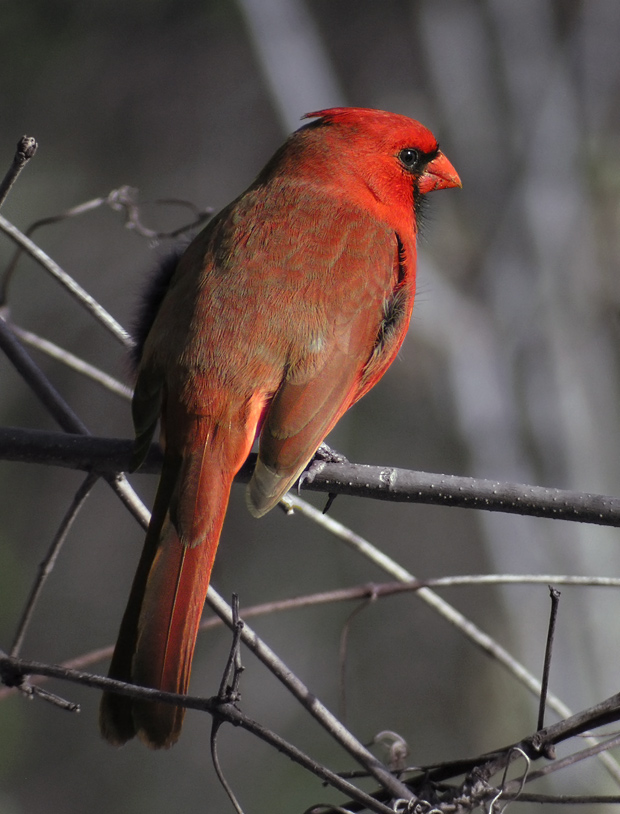
Northern Cardinal © 2011 Mike McDowell

Wednesday, January 12, 2011

Oh! It's Ley Lines!

Smug and self-assured, she replied ley lines were responsible for the recent mysterious spate of bird and fish deaths around the world, including the Arkansas blackbird incident. What are ley lines? I didn't know at the time, but I was reasonably certain it had to be nonsense after listening to her. You can read about them in detail on Wikipedia, but here's a short definition from the Skeptic's Dictionary:

"Ley lines are alleged alignments of ancient sites or holy places, such as stone circles, standing stones, cairns, and churches."



Wackadoodle alert!

From Archaeological Theory: An Introduction - Matthew Johnson (2010):

"Ley lines do not exist. This was shown by Tom Williamson and Liz Bellamy in Ley Lines in Question (1983), which analyzed such lines statistically and showed that the density of archaeological sites in the British landscape is so great that a line drawn through virtually anywhere will 'clip' a number of sites. It took Williamson and Bellamy a book's worth of effort and statistical sophistication to prove this, however."

Originally 'discovered' by Alfred Watkins in 1920, psychics, new age spiritualists, and other charlatans claim an energy complex re-discovered with divining rods proved ley lines exist and began ascribing mystical powers to them. Naturally, no modern scientific instrument can detect these asserted energy fields. This is both troubling and annoying because wildlife pathologists and biology technicians are diligently working with limited funds on finding real causes behind animal mortality events and population declines.

Claims without evidence that attempt to explain animal mortality events with mystical causes fail to offer any practical solutions. What would psychics and new agers have us do? Should we walk around with divining rods and point them at birds or something? Should we sprinkle pixie dust in our yards? Or maybe we can just think positively and the law of attraction will make bird populations rebound because we merely want them to. How insipidly moronic and arrogant! These non-experts think they know more about the nature of things than people who have been studying biology and ecology for most of their adult lives.

Bunk like this devalues the efforts of our professional scientists at a time when nature's critters need our help more than ever. By embracing this nonsense, why would such an individual feel inclined to back scientists with their money or vote? After all, they must believe scientists are simply wasting time on something futile because they know they're on wrong track. So, what's killing bats? Ley lines! It's ley lines, all the way down, and not geomyces destructans! Damn you and your science! I dare these wackaloons to call the Madison lab and tell them that.

People who attribute ley lines to animal deaths are so fail because they're counting hits but ignoring misses (confirmation bias). Why are there mass animal mortality events where there aren't any ley lines? Why are animals thriving where there are? They also fail to understand that a correlation is not necessarily causation. They probably believe ley lines explain other things, too, like car accidents, birth defects, mental illness, crop failures, etc. What can be asserted without evidence can be dismissed without evidence. Fortunately for the reality-based community, there's plenty of empirical evidence to help us explain what's going on with these unrelated animal mortality incidents. It just takes time and effort to get to the truth.

"That which is lacking in the present world is a profound knowledge of the nature of things; the fundamental truths are always there, but they do not impose themselves because they cannot impose themselves on those unwilling to listen."

~ Frithjof Schuon
Thursday, December 2, 2010

2011 PBC Phenology Calendar!


The 2011 Pheasant Branch Conservancy Phenology Calendar is out!

Adorned with beautiful nature photographs taken right at the conservancy by local photographers, learn about nature and science topics each month, including checklists for seasonal animal and plant activities, weather data, nature notes, and more. The calendar also features the 2010 photo contest winners. Perhaps best of all, your dollars will support the Friends of Pheasant Branch and their ongoing efforts to restore and protect one of the best natural areas in Dane County!

Link: Purchase the 2011 Phenology Calendar here!

Wednesday, June 9, 2010

Even Small Patches of Urban Woods Are Valuable for Migrating Birds


"Even tiny patches of woods in urban areas seem to provide adequate food and protection for some species of migrating birds as they fly between wintering and breeding grounds, new research has found. The results are important because, with the expansion of cities worldwide, migrating landbirds increasingly must pass through vast urban areas which offer very little of the forest habitats on which many species rely."

Link: Full article from ScienceDaily

Monday, April 26, 2010

eBird data at work!


"The previous 'Patterns from eBird' featured animated maps of Northern Cardinal based on predictive modeling. This time we'll take a look at how these maps predict migration in Eastern Phoebe, a widespread eastern species. Eastern Phoebe is the hardiest flycatcher in the United States and Canada, and in some areas it returns to the breeding grounds more than a month earlier than any other flycatcher. Its wintering range is largely within the United States, so these animated maps reveal its entire annual cycle."

Link: Full article and animated map at eBird.org

Tuesday, February 16, 2010

My GBBC Results!


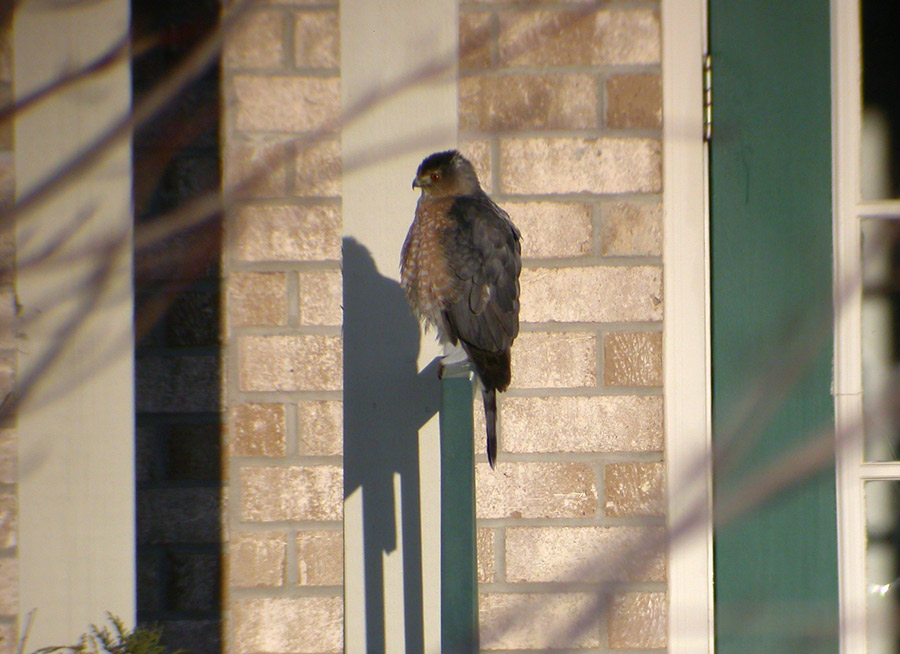
Cooper's Hawk hunting around my apartment complex.

Did you participate in the Great Backyard Bird Count?

Here are my results:

Locality: 53717, Madison, Dane County, WI
Observation Date: FEB 13, 2010
Start Time: 7:00 AM
Total Birding Time: 2 hours
Party Size: 1
Skill: excellent
Weather: excellent
Snow Depth: 6 - 8 in (15.2 - 20.3 cm)

Cooper's Hawk - 1
Red-tailed Hawk - 1
Mourning Dove - 5
Downy Woodpecker - 1
Blue Jay - 2
American Crow - 2
Black-capped Chickadee - 1
White-breasted Nuthatch - 1
European Starling - 2
American Tree Sparrow - 1
Dark-eyed Junco - 12
Northern Cardinal - 2
House Finch - 3
American Goldfinch - 2
House Sparrow - 4

Not bad for an apartment complex in an urbanized area, eh? The Cooper's Hawk was a nice surprise for my count, but the songbirds didn't appreciate the adept predator hunting through the bushes along the apartments. Typically I have more chickadees around, but saw only one during my count on Saturday. Perhaps this is a sign of chickadee intelligence (behavior) with regard to presence of a bird of prey?

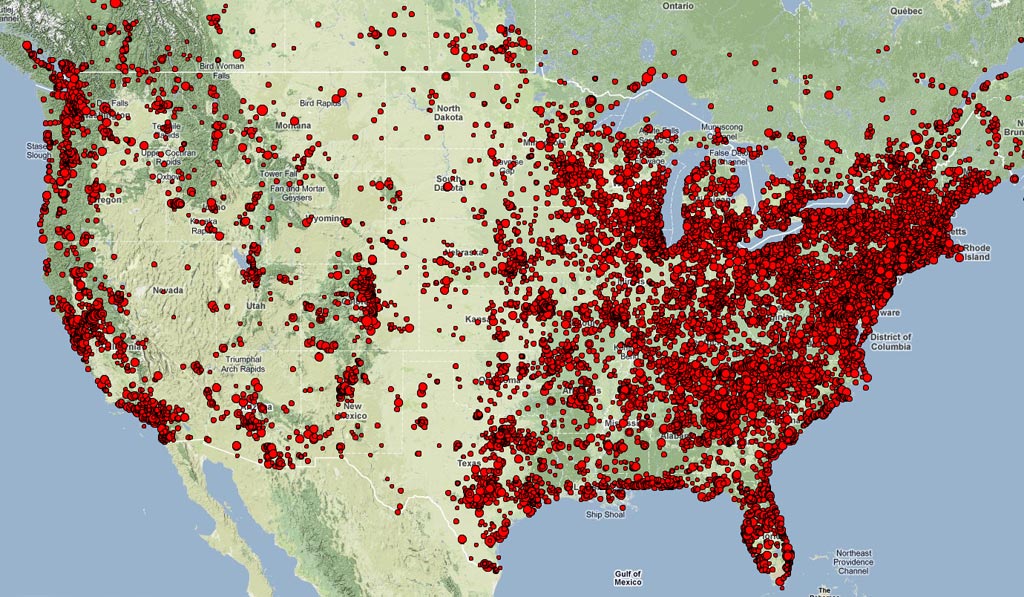
Here is 2010's GBBC participation map:


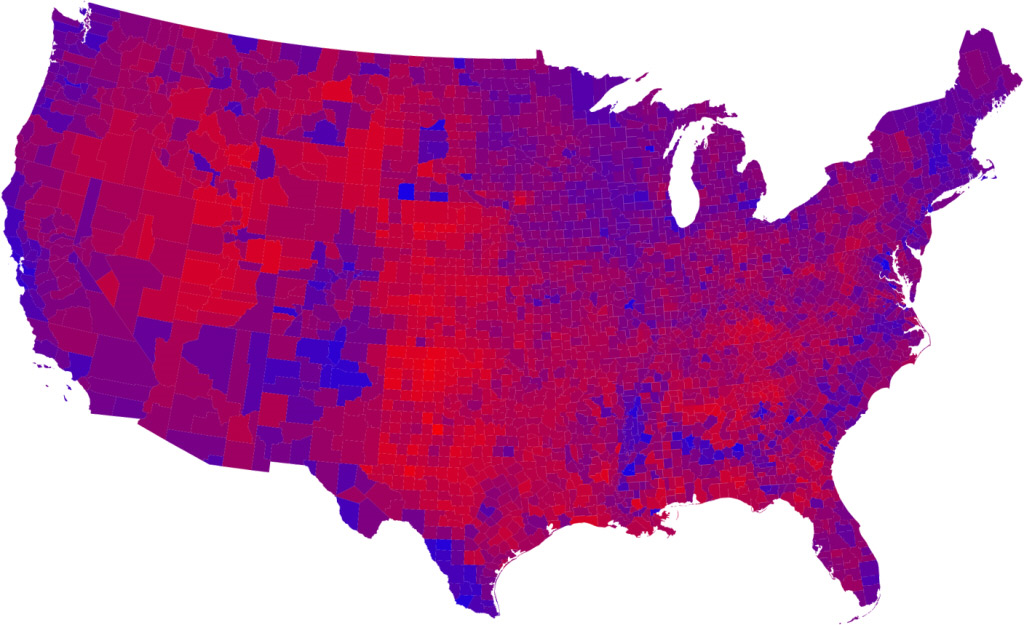
Here is 2008's Presidential Election Results map:


:: cackle, laugh, chuckle, chortle, giggle, snicker ::

© 2010 Mike McDowell

Wednesday, February 10, 2010

Great Backyard Bird Count 2010!


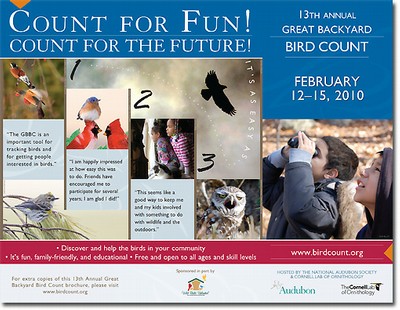
Don't forget this weekend is the 13th Annual Great Backyard Bird Count! The count will take place February 12th – 15th. You can participate just one day, or all four! To learn more about the count and how to participate, visit the GBBC website!

Sunday, April 12, 2009

Denial of Reality


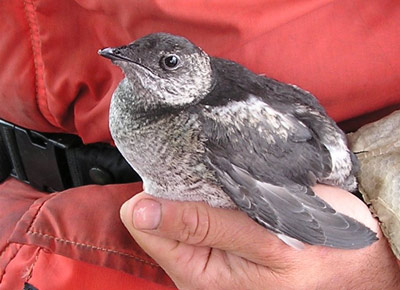
"On March 5, the Center for Biological Diversity filed a scientific petition with the Alaska Department of Fish and Game to place the Kittlitz's murrelet on the state list of endangered species. Today the commissioner of the Department of Fish and Game rejected the petition, claiming that there is 'insufficient information' to determine that numbers of Kittlitz's murrelets have decreased to a level that threatens the survival of the species. However, scientific studies clearly show that the species is threatened with extinction."

Kittlitz's Murrelet population numbers have plummeted by 80 to 90 percent in the past 20 years.

Link: Full article from the Center for Biological Diversity

I recall a bumper sticker that read: "If you ignore the environment, it will go away."

Kittlitz's Murrelet image USFWS DLS Library

Thursday, March 19, 2009

State of the Birds


"Birds are a priceless part of America’s heritage. They are beautiful, they are economically important—and they reflect the health of our environment. This State of the Birds report reveals troubling declines of bird populations during the past 40 years—a warning signal of the failing health of our ecosystems. At the same time, we see heartening evidence that strategic land management and conservation action can reverse declines of birds. This report calls attention to the collective efforts needed to protect nature’s resources for the benefit of people and wildlife."

Link: State of the Birds

Only after the Last Tree has been cut down,
Only after the Last River has been poisoned,
Only after the Last Fish has been caught,
Only then will you find that
Money Cannot Be Eaten.

- Cree Indian Prophecy

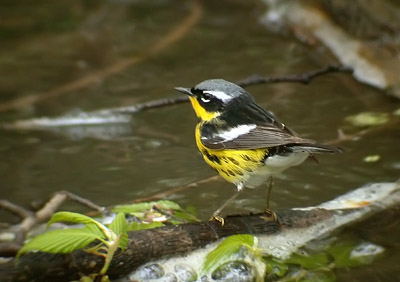
Magnolia Warbler © 2009 Mike McDowell

Monday, March 9, 2009

White-nose Syndrome


Though not a bird related article, I think the White-nose Syndrome (WNS) that's killing bats is a very important ecological issue to follow. This malady is named for a white fungal growth appearing around the muzzles and wings of bats as they hibernate in caves. The mortality rate of WNS is high; bat populations at some caves have declined as much as 90% in a relatively short timeframe – entire bat species are potentially at risk. It was discovered in caves in New York in 2006 and has since spread to Vermont, Massachusetts, and Connecticut during 2008. Already this year it's been confirmed in New Hampshire, New Jersey, Pennsylvania, and West Virginia. The cause of WNS remains elusive. The latest issue of The Nature Conservancy's magazine features an article on the plight that's killing our bats and is a very worthwhile read.

Link: In the Dark - The Nature Conservancy

© 2009 Mike McDowell