The following comment was received in response to
Birds of Prey and Rollers...
Mike,
Perhaps you haven't read the part in the NBRC response where they mention that Racing Pigeons are also a staple in the diet of these winged thugs. It's a little further down where you may have stopped reading. Perhaps you chose to omit that bit of knowledge to help your argument. Much like the popular media, which as we all know is fond of Paris Hilton and simultaneously makes even the most profound event a circus presentation of cliches and quantities measured in terms of SUVs and football fields all the while grinning through manicured mandibles, you have chosen to ignore that the sport of Pigeon Racing is also being decimated by the same urban feathered opportunists. The reason that statement was put into the response by the NBRC is to show that there are more domesticated breeds affected than just Roller Pigeons. Not only domestic breeds, but wild bird populations are being destroyed systematically, with the protection of the government. These breeds and wild species don't exhibit the USFWS's unwarranted "professionally" ascertained label of having a "genetic defect" (sarcasm intended). This is important because there is a chasm of difference between Roller Pigeons and Racing Pigeons. Of course you probably didn't want to introduce that complexity into your "reading".
Migratory birds, which entails everything from Cooper's hawks to Grackles, have one thing in common; THEY MIGRATE. They move on based on seasons and food supplies. The 1918 law which was agreed upon by the North American nations was intended to prevent any one of these countries from poaching too many of the same species, like the Passenger Pigeon. The law was passed in 1918.....almost 90 years ago, when circumstances were very different from today. To blindly believe that continued conservation in the direction of raptor populations would not at some point cause a tipping of the scales in the favor of the raptors is to be truly closed minded. At the very minimum no biologist to my knowledge and definitely no one at the USFWS has ever come out publicly to raise the possibility that this may be the case. I can only guess that it would greatly work against them when they next seek increased funding. But that's another thread that needs development. Don't ever be lulled into believing that your public servants don't have a built-in biased when it comes to their findings, studies, and reports, when their budget is sacrosanct and it is their raison d'etre.
Racing pigeons are bred for speed, endurance, strength and determination. They are thoroughbreds of the sky and they don't roll, they don't have the "genetic defect" that these idiots at the USFWS like to say Rollers posses. Really, how irresponsible to make such a statement. They, of any domestic or wild prey species, logic would dictate, should stand a better chance than rollers, and even better than most wild bird species. However, they don't. Any racing homer breeder would need several digits to count his yearly losses. This speaks volumes of the density of cooper's hawks specifically. That racing homer enthusiasts are being systematically quartered by these aerial wolves should give you some glimpse as to the real "HAWK PROBLEM". Unlike their rural counterparts, urban cooper's hawks come in multiples. They attack from several angles concurrently. There is usually more than one lying in wait for a meal to pass by. Roller or not, they destroy the habitat they have claimed theirs. They jump from tree to tree, like a rolling plague of locusts, eating song bird nestlings en masse. It doesn't matter that the birds being eaten have that much meat on them. Any biologist specializing in avian species will tell you the same. Cooper's are opportunists and will clean out a thicket of nesting birds regardless of age. They are even known to eat other hawks' nestlings.
However, like the media outlets that try to drum up readership, it's not a compelling story when the weaker side has as strong an argument, though just out of reach because of the obscurity of the demographic group, as that of the government's. You choose to recognize that it is only Roller Pigeons that are being taken out because it is easy to criminalize people already facing prosecution. You mislead your readers into believing your poorly researched article is somehow valid. They applaud you as if on cue. Have we not learned, time and again, to seriously question your government's findings? How many innocent people have to rot in prisons, wrongly convicted by your government. The government is composed of individuals, like you and me. Each with his own agenda, each with his god given set of flaws and vices. In other words, they are human.
That because they have a "genetic defect", which, by the way, no knowledgeable and honest biologist will ever stake his career on since nothing is a defect but instead a mutation, that because of this Roller Pigeons somehow deserve, in some twisted way, to be slaughtered, well, that's as blind as believing your load of feces. Well, Mike, astute as you might think you are, you strike me as being similar to these reporters who love to toss around emotionally charged comments based on little or no knowledge of the actual subject. Sure you have a bit of an audience here, on this blog, who, like well trained guest audiences, applaud you when you say those oft tossed about phrases that seem to be ingrained in the typical American response pattern. You are a weak Oprah, even a Springer of the blog world. Congratulations.
For your education, Cooper's Hawk populations have indeed exploded. One study from the USFWS itself states that they have banded over 50k Cooper's since the mid 70's, and they further claim to only recapture 10% of those previously banded. Further, by the Audubon Society's own count in their Christmas Bird Count, since 1970 Cooper's have gone from a total "observed" number of about 700 to close to 7300. Observed is the key word. The number per party (observer) hour jumped from 0.0162 to 0.0645. That number is more important than the raw numbers since it is an indication of the density of this population of hawks. That is a massive increase. Further, Cooper's hawks are traditionally very hard to count since they tend to stay in the brush when in rural areas, and in trees and between homes in urban areas. They don't fly in the open, or regularly soar like a Red Tail hawks. In the same Audubon Society CBC, summaries of certain regions with regard to the Cooper are quoted as stating that the Cooper's "population explosion knows no bound". With words like that coming from the same Audubon Society that last month listed the 20 species of common birds that are currently and rapidly disappearing from our environment, all of which are prey species to the Cooper's, you have to wonder who has done their research. I can certainly say that you didn't, Mike.
My response:From fossils collected in California, New Mexico and Florida, Cooper's Hawks have existed in North America since at least the late Pleistocene (half a million years ago). Birds that constitute traditional prey items for these and other raptors somehow managed to flourish for tens of thousands of years in their presence, including the Passenger Pigeon. So contrary to your opinion, hawks are not destroying native bird populations. Conservatively, the estimated annual number of North American migratory birds that perish from colliding with human made structures during migration is 100 million. Some suggest this number is as high as a billion birds each year. As tragic as either figure is, the number one cause of the decline of bird populations is still habitat loss and fragmentation. Like the demise of the Passenger Pigeon, we’re to blame for this – not hawks. That there is shrinking (and/or shifting) habitat for hawks to hunt on is most telling in the context of your hobby, and though they seem to have adapted well to urbanized settings, collisions with man-made objects accounts for 70% of deaths in urban Cooper's Hawks. Roller Pigeon fanciers will not win the hearts and minds of birders and bird watchers by vilifying raptors with junk science and employing
ad hominem attacks to anyone who disagrees with them.
References:
C. W. Boal, R. W. Mannan 1999. Comparative breeding ecology of Cooper's Hawks in urban and exurban areas of southeastern Arizona. J. Wildl. Manage. 63(1): 77-84.
W. A. Estes, R. W. Mannan 2003. Feeding behavior of Cooper's Hawks at urban and rural nests in southeastern Arizona. Condor 105: 107-116.
S. D. Emslie, J. D. Speth, R. N. Wiseman 1992. Two prehistoric Puebloan avifaunas from the Pecos Valley, southeastern New Mexico. J. Ethnobiol. 12: 83–115.
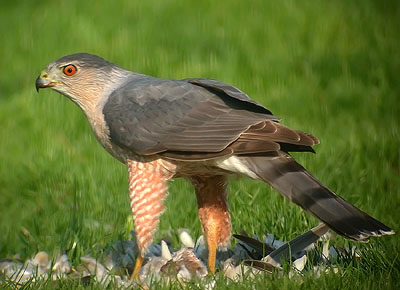
Cooper's Hawk image © 2007 Mike McDowell