Wednesday, March 1, 2006

Cerulean Warbler: A Songbird At Risk


SELC files suit against federal agency to protect disappearing songbird

"The Southern Environmental Law Center has filed suit against Interior Secretary Gale Norton and the U.S. Fish and Wildlife Service for ignoring a citizens petition filed five years ago seeking to list the rapidly declining Cerulean Warbler. There are fewer than 20% of the songbirds today than in the 1960s. The agency has failed repeatedly to meet deadlines set forth in the Endangered Species Act for responding to citizens petitions. SELC filed a petition in 2000 on behalf of 28 conservation groups across the East - including the National Audubon Society - to list the Cerulean Warbler as a threatened species."

Link: Full Article from Southernenvironment.org

Link: All about the Cerulean Warbler from Cornell

Cerulean Warbler drawing © Robin Street-Morris used with permission.

Tuesday, February 28, 2006

Curse of the Were-Warbler!


(click on image for larger version)

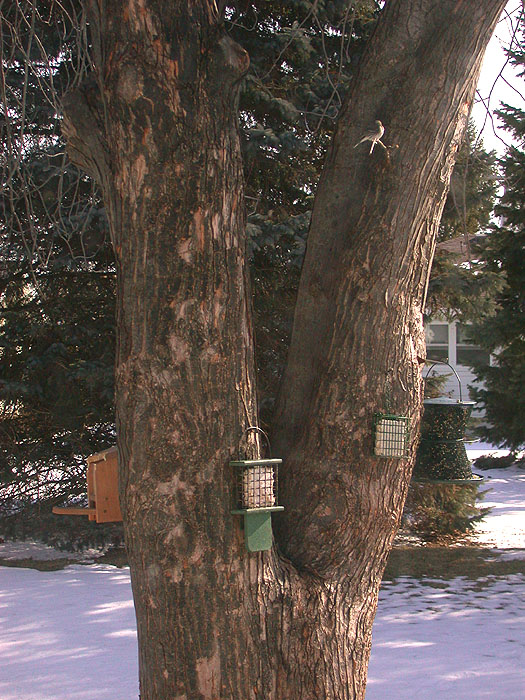
Hey, don’t get me wrong here…I think it’s super cool having a backyard YELLOW-RUMPED WARBLER through the winter (I love it, as you can plainly tell). However, in the past several days its behavior has changed…just a little. The warbler is getting feisty and territorial toward other birds attempting access to the suet feeders. It almost makes me feel bad for the other small birds. Oh, it’s smart enough to leave the Red-bellied, Downy and Hairy Woodpeckers alone, but it still remains close by and watches their every move.


(click on image for larger version)

There is a thin branch just above the feeders the warbler likes to perch on…here it waits and watches. Sometimes it doesn’t even matter if the offending bird is clear on the other side of the maple - it’s chased completely out of the yard, sometimes even further. Any junco, finch or chickadee that gets too close is met with furious harassment and a barrage of chip-notes. I’ve seen warblers chase each other during spring migration, but this stakeout-like behavior is quite the spectacle. I wonder if it is guarding the food or if it is just a territorial instinct for the species this time of year? Perhaps its brethren to the south also closely guard a small territory over the winter months.


(click on image for larger version)

The warbler isn’t quite fast enough to give the Red-breasted Nuthatches much grief, and interestingly enough it doesn’t bother the Brown Creeper. But finches, juncos and chickadees represent a big problem that apparently must be met with a forceful reaction from the warbler. As much as I enjoy this bird, spring probably can’t come soon enough from the perspective of some of the other songbirds of our backyard.

All images © 2006 Mike McDowell

Friday, February 24, 2006

Curlew Caper Concludes


Someone I know emailed the secretary at TBRC concerning the Eskimo Curlew photographs and was intrigued by my evidence. The secretary said he thought the color shot was colorized by Bleitz’s foundation (now the Western Foundation of Vertebrate Zoology) that holds the copyright. He also wrote that Victor Emmanuel was present with Bleitz when the photographs were taken and the TBRC received them from Victor.

Don Bleitz died in 1986:

IN MEMORIAM: DONALD LOUIS BLEITZ

"Natural History Museum of Los Angeles County, Los Angeles, California 90007 US Donald Louis Bleitz, a Member of the A.O.U. since 1947 and an Elective Member since 1985, died 23 June 1986 in Los Angeles, California. Don Bleitz was born in Los Angeles, California, on 1 October 1915. As a professional photographer and inventor of numerous photographic devices and techniques, Don Bleitz revealed his considerable ability and deep interest in the photography of birds. During his lifetime he photographed more than 600 species of North American birds; one of his most outstanding contributions was obtaining the first good photographs ever, anywhere, of the Eskimo Curlew (J. V. Gollop 1986) in 1962. It was Don's life-long plan to publish a sumptuous, many-volumed work on the birds of North America, using his wealth of excellent colored photographs. This worthwhile project never came to fruition. He did, however, author numerous feature articles in the Saturday Evening Post, Reader's Digest, and Arizona Highways. A member of numerous scientific and civic organizations, Don Bleitz was a Life Member of the A.O.U., the Cooper Ornithological Society, and the Wilson Ornithological Club. He was a member of both the Western and the Eastern Bird Banding Associations. In 1952 he founded the Bleitz Wildlife Foundation, an organization devoted to wildlife preservation and study."

I believe the top three photographs are authentic, but I’m convinced the 4th shot (bottom picture) was assembled/manipulated from the top image. Reading this memoriam on Bleitz, perhaps we can glean some insight into Don’s motive (assuming it was him) for rendering the 4th image. He wanted to produce “a sumptuous, many-volumed work on the birds of North America, using his wealth of excellent colored photographs.” Perhaps all he wanted was a color image of an Eskimo Curlew and the only way to get one was to use one of his black-and-white images, make it appear to be a different bird and colorize it. This is pure conjecture on my part in an attempt to establish a motive, but I think it matches the evidence pretty well.

Case closed? I think so.

Wednesday, February 22, 2006

What the heck?


Ted Eubanks of Galveston, Texas recently posted to TEXBIRD that the World Birding Center and Houston Audubon intend to search for the ESKIMO CURLEW. This, itself, is pretty interesting news. But what presently interests me more is the link he provided to the only known color photograph of the species taken by Don Bleitz in 1961 or 1962.

When I clicked to display a larger version, something about the picture didn’t look quite right to me. For one, the depth of field seemed a little odd – I noticed that the bush behind the bird seems to be in as good of focus as the bird itself. There is also something a little suspicious and unnatural looking about the contrast and lighting differential between the bird and the background.

I decided to google search on "Don Bleitz" and came up with a link that took me to the Texas Bird Record Committee website showing several black-and-white photographs of Eskimo Curlews (two birds?), including a black-and-white version of the above color image. After studying the images, something about the top and bottom pictures caught my eye, so I loaded both images into Photoshop to scrutinize them in detail.

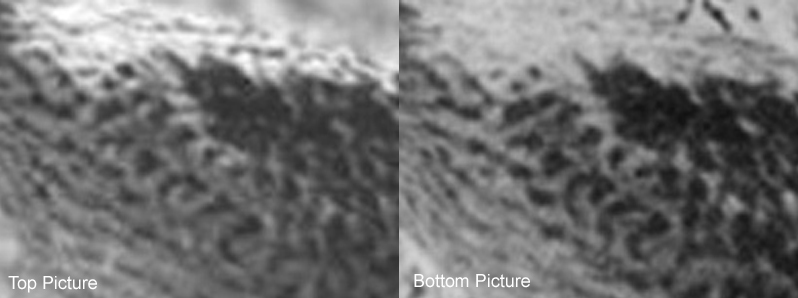
I horizontally flipped the top image and resized the other image so the curlew was exactly the same pixel width in both images. Using the angle of one of the bird’s legs as a guide, I slightly rotated the bottom image clock-wise. Using the select tool, I cropped each image from the bird’s eye to what appears to be a stick near the ground or the bird’s hallux on the trailing leg. This rendered a very curious result to my eye – the birds in the two cropped images bear an uncanny resemblance. Look at the plumage patterns, lighting angle and how every mark matches perfectly.

I’ll concede there are some subtle differences, such as the curve of the bird’s bill, the leg width varies a little in places and the tail comes to more of a point in the bottom picture. I don’t know what kind of image manipulation technology was available in 1962, and I’m not questioning the authenticity of the top three images. But I am very curious about the bottom image, and additionally the colorized version of it.

The only thing I am certain of is that if they are indeed different pictures of the same bird (but what about that bill?), then one of them was flipped horizontally because there is undeniably no question in my mind that it is the same side of the bird upon close inspection of the plumage patterns.

Perhaps this is old news and the picture is known to be manipulated, but then what is it doing on a records committee website? Also, why fake an image for a records committee if you already have a couple other authentic ones? Unless for some peculiar reason it was necessary to put the curlew in the specific background we see in the bottom (and color) image.

What do you think? Am I completely off my rocker on this? Hmmm. Maybe you shouldn’t answer that.

Tuesday, February 21, 2006

GBBC Results


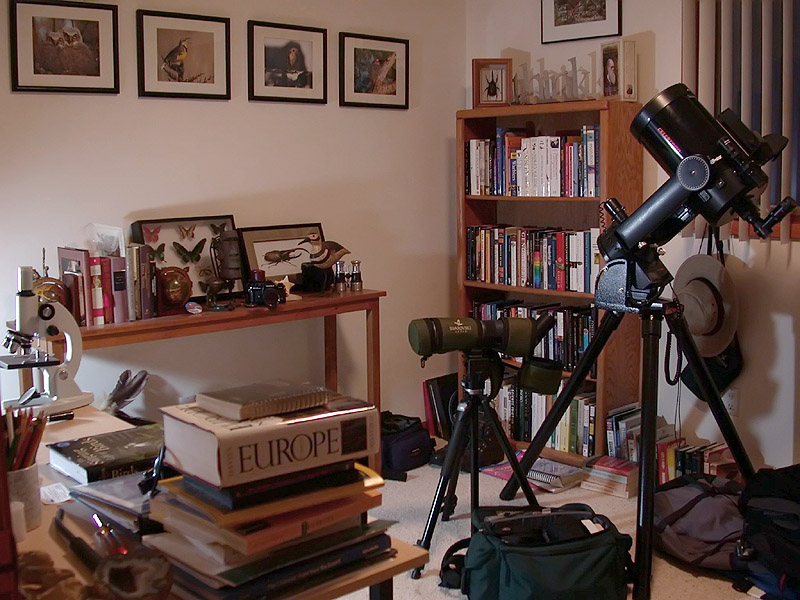
Den of the Citizen Scientist/Amateur Naturalist

I tallied the only YELLOW-RUMPED WARBLER in the state of Wisconsin on the Great Backyard Bird Count this past weekend. Though all counts might not yet be submitted, presently there are several other single species records on our state list:

Long-tailed Duck
Red-shouldered Hawk
Eastern Screech-Owl
Wilson's Snipe
Iceland Gull
Thayer's Gull
Varied Thrush
Yellow-rumped Warbler

If you have some time, check out "Explore the Results" on the GBBC website - pretty interesting to compare state data, previous year counts, maps and more. This is such a wonderful program for people to participate in and the data collected can be very helpful to identify various trends, population shifts, etc.

GBBC totals for my 3 hour count:

Cooper's Hawk - 1
Mourning Dove - 3
Red-bellied Woodpecker - 1
Downy Woodpecker - 1
Hairy Woodpecker - 1
Blue Jay - 4
American Crow - 3
Black-capped Chickadee - 2
Red-breasted Nuthatch - 3
Brown Creeper - 1
Yellow-rumped Warbler - 1 Confirmed
American Tree Sparrow - 2
Dark-eyed Junco - 7
Northern Cardinal - 6
House Finch - 1
American Goldfinch - 4
House Sparrow - 5

Den image © 2006 Mike McDowell